Two clipping campaigns at once is not a speed problem. It is a spec problem and a budget problem. A Content Rewards offer stops paying the moment its maximum payout is reached or its end date arrives, and there is no warning shot before it happens. So the goal is not to work twice as fast: it is to run one production pass that satisfies two spec sheets, two approval gates and two folder rules. This is that system, from what to read before the first cut to the point where a third campaign stops being free money.
Why one campaign cannot fill a week
The arithmetic of a clipping campaign is set by the seller, not by you. Whop's Content Rewards terms describe the three dials a brand turns: a rate per 1,000 views (their own example is one dollar per 1,000 views), a maximum payout, and an end date. When the maximum payout is met or the end date arrives, whichever comes first, the offer closes and views generated after that point are not compensated.
That is why a single campaign makes a fragile week. It can pay well on Monday and be effectively over by Thursday, with nothing in your workflow warning you. The second reason is approval: a clip is paid only once the seller approves the submission, so a rejected clip is a lost slot rather than a delayed one. The third is that two campaigns rarely pay the same rate, so the same evening of work is worth different amounts depending on where the clips land.
Two campaigns smooth all three. A budget running dry no longer empties your week, a streak of rejections on one campaign is absorbed by the other, and you can point your strongest clips at whichever campaign pays the most per 1,000 views.
Source: the Whop Content Rewards terms of service define Rate, Maximum Payout and End Date, and state that compensation stops once the maximum payout is met.
Before the first cut: turn two briefs into two comparable spec sheets
Nobody runs two campaigns badly on purpose. They run them badly because the two briefs live in two browser tabs and in two different shapes: one is a paragraph in a message, the other a document with screenshots.
Fix that first. For each campaign, copy the offer details onto one page with the same seven lines:
- clip length: minimum, maximum, ideal
- format and aspect ratio
- caption rule: burned in or not, and the style that was approved
- safe zone for the platform the clips will be posted on
- opening rule: what has to be in the first two seconds
- platforms and accounts allowed
- deadline, approval window, rate, maximum payout and end date
Written side by side, the two sheets do two jobs at once. They show you where the campaigns diverge, which is your per-campaign work, and where they agree, which is your shared work. In most pairs the mechanical pass - cutting, reframing, captioning - is nearly identical, and the real differences sit in selection, length and packaging.
Length is the field people assume is standardised and is not. YouTube still describes Shorts as videos of up to three minutes, TikTok's own specification page spells out its resolution and ratio expectations, and a campaign brief can be stricter than either.
Sources: Get started creating YouTube Shorts, TikTok video specifications and the Whop Content Rewards setup guide, where the fields a brand actually fills in are listed.
One pass, two campaigns: build on the strictest spec, then trim down
The instinct is to run two production lines, one per campaign. That is the expensive way, and it doubles every mistake.
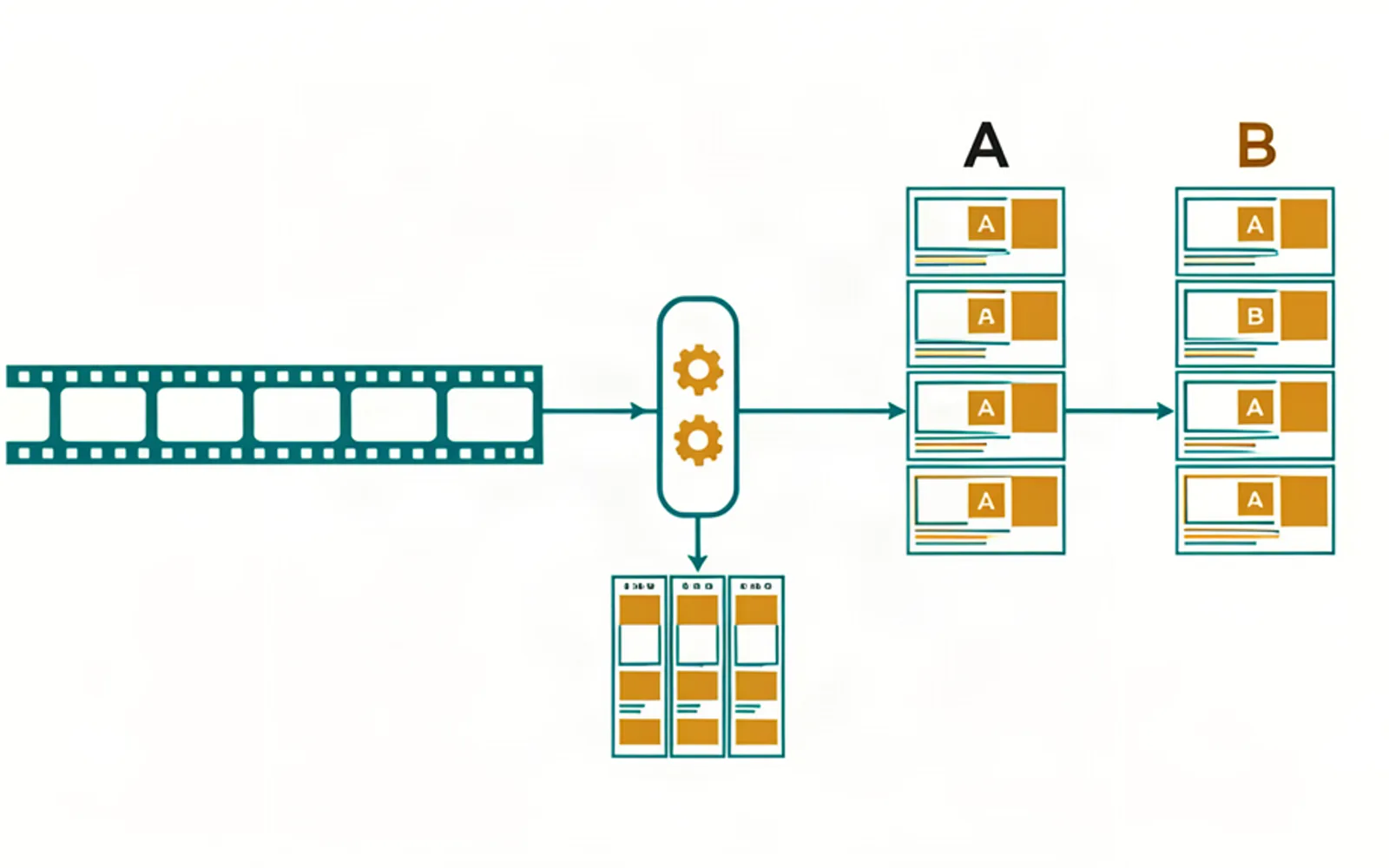
Run one line and let the strictest spec set the floor. If campaign A accepts 45-second clips and campaign B caps at 30, cut the moment at 45 and derive the 30-second version from it: you can always shorten a clip, and you can never lengthen one you already exported. The same logic applies to captions and framing. When the two campaigns disagree, start from the heavier caption treatment and the tighter safe zone, then derive the permissive version by removing something.
Selection is the stage where the campaigns genuinely separate, and it is also the stage not to automate away. A moment that fits one campaign's audience can be a dud for the other, and only the person who read both briefs knows which is which. If the prep stage is where your hours actually go, the prep pass for footage is the one to fix first, because both campaigns inherit it.
- Prep the source once: the same folder scheme and the same single triage pass give you the candidate moments with in and out timecodes.
- Tag every candidate with the campaigns it could serve, before any export exists.
- Run the mechanical pass once - cut, reframe, caption - on the strictest of the two specs.
- Derive the looser version from the strict export, then file each version in its own campaign folder.
The mechanical half of that pass is what the clip production line behind ClipFinish is built to absorb, across a whole batch at once. It does not choose the moment, which stays with you, and it does not touch the selection you just protected.
The folder and naming rule that makes a mix-up impossible
A mix-up between campaigns is not a small embarrassment. Posting campaign A's clip into campaign B's submission thread usually breaks the offer requirements, and at worst it reads as a double payout attempt, the kind of thing a campaign treats as fraud rather than as an accident.
One rule prevents all of it: no folder ever holds two campaigns. Every exported file carries its campaign prefix, the source identifier, the moment number and a version, in that order: A-techtalk-014-v2, B-techtalk-014-v1. The moment that serves both campaigns is exported twice, once into each folder. It is never moved, never copied by hand, and never left in a shared clips directory to be sorted later, because sorting later is what produces the incident.
One more thing worth knowing: submissions are made by link, and the campaign checks the submitted link against its own requirements, not against your intentions. A clip that fails a conformance check is rejected before anyone watches it, a waste you can remove entirely at the export stage. The five mismatches behind most campaign rejections are exactly what to verify before you export anything at all.
The week: two sessions per campaign, and a buffer you do not spend
Two campaigns do not need twice the days. They need two sessions each, plus a rule about what happens when one of them slips.
Work backwards from each campaign's deadline and place one batch session in front of it. Keep the second session as the one that absorbs approval rejections and late brief changes. A campaign that closes on Friday with a seven-day approval window means clips cut on Monday, approved by Wednesday, and a Thursday session free to re-cut whatever came back rejected. The daily volume a campaign actually asks for is what tells you whether that session fits, and batching the passes is what keeps a session from spilling into the next day.
The chart below is the shape most clippers land on: campaign A takes the shorter session but pays the lower rate, campaign B takes the longer session and the higher rate, and neither session sits back to back with the other campaign's. Back-to-back sessions are how specs get mixed.
Then leave the buffer alone. It is not spare capacity for a third campaign, it is what stops a Thursday rejection from becoming a lost week.
When a third campaign stops being free money
Adding a campaign has a fixed cost that does not scale with volume, and that is why a third campaign is usually a mistake well before it becomes a quality problem.
Per campaign, every week, you pay for: reading and re-reading the offer details, checking that the budget is still alive and the rate has not moved, reading approval results, re-cutting rejections, reporting, and keeping account and platform constraints straight. That overhead is per campaign, so it does not get cheaper because you cut fewer clips. Your clips per hour can be excellent and the week can still be worse than it was with two.
The test is arithmetic, not instinct. Take your real minutes per clip, multiply by the new campaign's weekly quota, add the per-campaign overhead you measured over the last two weeks, and compare the total with the hours you actually have. If the number does not fit, the answer is not a faster edit. It is a fourth session you will end up skipping.
- Can you run two clipping campaigns at once?
- Yes, and for most clippers it is safer than one: a campaign stops paying once its maximum payout is reached or its end date passes, so a second campaign is what keeps a week from going to zero. Run it as one shared production pass with two spec sheets, not as two separate pipelines.
- What happens when a campaign reaches its maximum payout?
- Per Whop's Content Rewards terms, the offer closes once the maximum payout is met or the end date is reached, whichever comes first, and views generated after that are not compensated. Check the budget before you cut, and keep the second campaign's batch already scheduled.
- Can the same clip be submitted to two campaigns?
- That depends entirely on the offer details and is not a safe default. Some offers require exclusive clips, and sending the same file to two brands can be treated as a payout attempt on content you did not make for the second one. Export a version per campaign and read the requirements before you submit.
What to keep from all of this: a clipping week survives on two campaigns, one shared mechanical pass and one folder rule. Re-read both offers on the day you cut, build on the strictest spec and derive the looser version from it, give every file its campaign prefix, and hold one session per week back as buffer rather than as capacity.
ClipFinish occupies the shared part of that system. Its clip production line takes one source and renders the vertical set in a batch - cutting on the timecodes you marked, reframing to 9:16, keeping captions consistent across the whole batch - so the mechanical pass runs once instead of twice. What it does not do is worth stating plainly: it does not read the two briefs for you, it does not decide which campaign a moment belongs to, and it will not submit anything or track your approved views. Those stay human, and they are exactly what decides whether a third campaign is worth taking.