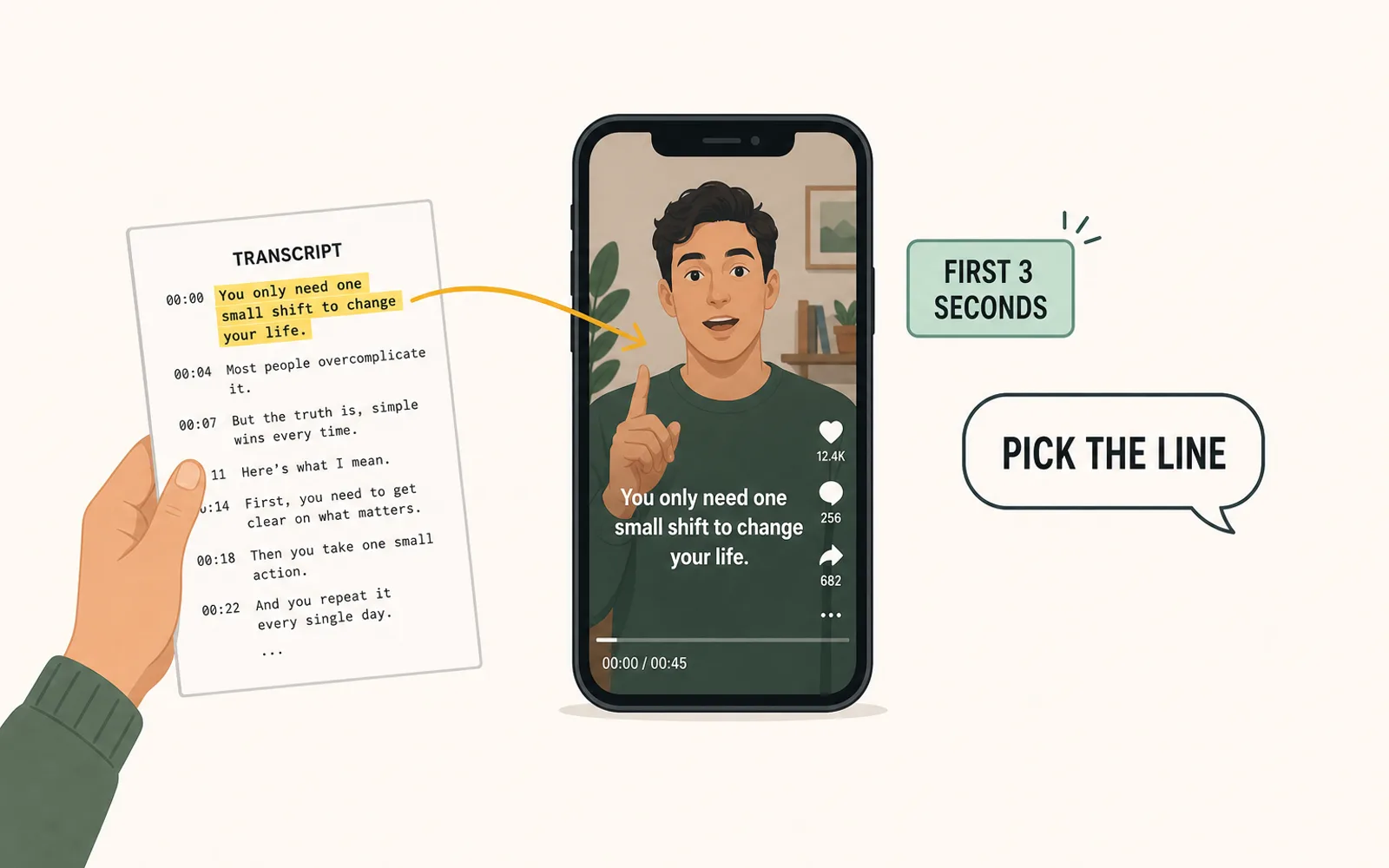
When you cut a short from a longer video, the first three seconds are where it is won or lost — and the opening that stops the scroll is rarely something you write. It is almost always a line that already exists in the source: a sentence that stands on its own, interrupts the expected rhythm, and points at the payoff to come. Finding that line is a reading task in the transcript, not a writing task on the timeline. This article gives you the exact checks to run while you read, and the honest split between the choice you keep and the clip work you can hand to a machine.
The first three seconds decide whether a short gets watched
Retention on short video is not a gentle curve — it is a cliff at the front. A viewer in a feed decides almost immediately whether to keep watching or swipe, and the steepest drop in a clip’s audience-retention report is usually at the very start. YouTube’s own analytics name the place where viewers abandon a video, and it calls out the first moments and where dips land: for a short, that dip sits in the opening seconds. Everything you want the viewer to see — the point, the caption, the payoff — sits downstream of that single decision. If the first line loses them, none of the rest is ever reached.
The trap is that most of the production effort goes below that fold. Framing, reframing, captions, colour and export are where the hours go, and none of it is seen if the opening does not land. The moments that decide whether the clip is watched happen before most of the work is even visible. That is not an argument to neglect finishing; it is an argument that the opening deserves a deliberate choice, made before the batch is cut — the same kind of choice that decides how the clip ends so it finishes instead of just stopping.
A strong opening already exists in the source video
When you cut a clip from a stream, a podcast, a talk or an interview, you are not making a standalone film — you are lifting a real moment out of something that was actually said. That constrains the opening more than it helps. In theory you could bolt any attention-grabbing first line onto the clip, but a cold open that promises something the source never delivers reads as fake in about one second. An opening that was genuinely spoken is honest; a manufactured one that the clip cannot pay off is a mismatch the viewer feels immediately, and it burns the clip’s one shot.
So the job is not to write a hook for the clip. It is to find the strongest line that already exists in the source and can truthfully sit at the front — the sentence that would still make sense to a stranger who started watching at exactly that second. This is why the transcript matters so much in short-form work: it collapses hours of source into minutes of text, and the line that can open a clip announces itself in the words, not in the frames.
That is the honest boundary of clip-making. You can choose which line opens, but you cannot invent a better one than the source supports and still call the result a clip of that person. Choosing the real, strongest line beats inventing a louder fake one every single time.
Find the opening line: three checks to run on the transcript
Reading a transcript instead of scrubbing a timeline is the fastest way to find an opening, because a clip-worthy line is a property of the words, not of the picture. Open the transcript of the source, scan its opening stretch, and run every candidate against three checks:
- It stands alone. A stranger who starts on this sentence should not need the sentence before it. If the line depends on context you would have to add, it cannot open a clip.
- It interrupts. It breaks the expected rhythm — a surprising claim, a strong opinion, a concrete number, a contradiction. The opposite is the throat-clearing opener (“so today I want to talk about…”) that tells the viewer nothing is coming.
- It leads somewhere. It makes the viewer sense a payoff and stay to reach it. A line that merely surprises but goes nowhere holds for three seconds and then loses them.
Mark every line that passes two or three of the checks, then choose. You do not need the best line to sit at minute zero: if the strongest candidate is two minutes in, you can still open on it and play to it, as long as the clip’s story then earns that opening. What you are looking for is the earliest line that is both strong and true to the clip that follows.
You choose the opening; the machine cuts and finishes the batch
Once the opening is chosen and the clip is defined, everything left to do is the same for every clip in the batch: cutting at the marked timestamps, framing to the ratio, captions, safe zone, export. That work is repetitive, and repetition is precisely what a machine is for. This is the boundary that actually holds in short-form production — the creative choice of which moments, and which line opens, stays yours; the mechanical finishing is delegated. It is the deeper argument about AI clip tools: automate the part that is identical, keep the judgement that changes with every clip.
ClipFinish’s clip production line is built around exactly that split. You drop in the long source, read the transcript and mark the moments — the opening line you chose among them — then set the framing and caption style once and receive the whole batch finished. ClipFinish gives you the text to read and the production to finish; it does not choose your opening, invent your hook, or decide which moments are yours. That part stays a human call, and it is the part worth keeping.
Hooks and openings: quick answers
- How much time do I actually have to hook a viewer on a short?
- Short-form retention reports usually show the steepest loss in the opening seconds. Treat the first line and the first moments as the decision point: if the strongest material is not audible or visible within the first few seconds, it is not the opening.
- Should I write a brand-new hook for a clip cut from an existing video?
- Only if the source genuinely never states the idea. For a clip that is a real slice of a stream or a podcast, the opening that works is a real line from that source that stands alone. An invented hook the clip cannot pay off reads false and wastes the first seconds.
- What makes a line good as an opening?
- Run the three checks: it stands alone, it interrupts, and it leads somewhere. A line that passes at least two is a candidate; the earliest candidate that is also true to the clip is usually the opening.
- Does choosing my own hook mean rejecting AI tools?
- No. You can delegate the repetitive finishing and still keep the choice. The tools that work hand you the material to read and the production to finish; the tools that fail decide your moments and your hook for you.
- Does the opening matter as much as the ending?
- They are the two ends of the same problem. The opening is where the viewer decides to stay; the ending is where they decide the clip finished well. A clip needs both to hold, and both are found by reading the source rather than cutting harder.
The hook of a short is not the part you edit hardest — it is the part you choose best. Read the source transcript for the line that stands alone, interrupts and points somewhere, and put it at the front; everything you did to make the clip good is wasted if the first three seconds let the viewer go. That choice is yours to make, and the production around it is exactly the repetitive work ClipFinish’s clip production line automates: you read the transcript, mark the moments including your opening, and get the batch back framed and captioned — while the one judgement that makes a clip yours, which line opens it, never leaves your hands.