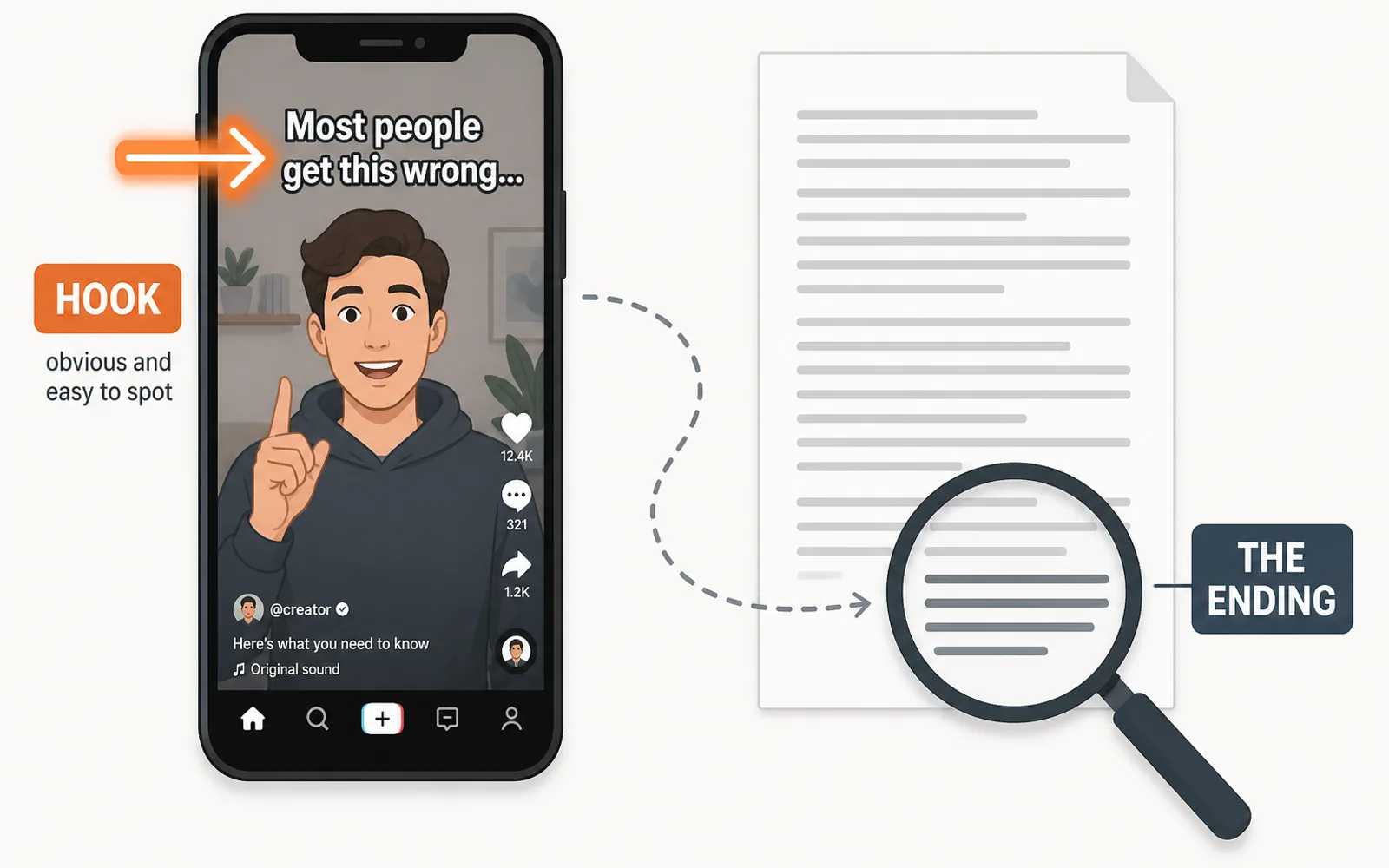
How do you end a short video well? Most clip work plans the opening and improvises the ending, and the result is a batch of clips that stop rather than finish. That is not a lack of editing skill: a good ending is not built, it is found. It is the moment in the source that stands alone and closes on something, and finding it is a reading task, not a cutting one. Here is how to read a transcript for the passage that ends a clip properly, and the honest role a clip tool plays in it.
Everyone plans the hook; the ending is improvised
When you make a short from a longer video — a stream, a podcast, a talk — the checklist everyone knows by heart starts with the hook. First three seconds, a surprising line, cut the cold open. There are whole feeds and tutorials devoted to hooks, and almost every editor can recite the rules.
Ask the same editor about the ending and the advice goes quiet. "End it before they get bored." "Cut it tight." The ending is treated as wherever the clip happens to stop, as if it needed no plan of its own. Look across a clipper's portfolio and the pattern is visible: nearly every clip opens on something strong, and a surprising number simply run out of steam a beat before a real close — they trail off, or stop on a line that was setting something up.
The asymmetry is structural, not a bad habit. A hook is a sample you can steal: any surprising first line interrupts the scroll, even when it has little to do with what follows. An ending has to belong to this one clip, which is why it is harder to copy and harder to get right. That is the gap this article is about.
Why a good ending is harder to find than a good hook
A hook is easy to borrow because its whole job is to interrupt. It does not have to be true to the video; it has to stop the thumb for three seconds, and a good cold open does that by surprising or by withholding.
An ending has the opposite job. It has to close the promise the clip just made. If the clip is about one idea, the ending is where that idea resolves, lands, or turns. Get it wrong and the clip does not feel short — it feels unfinished: cut off mid-thought, ending on a beat that set something up and never paid it off. A short that ends on a cliffhanger it never resolves reads as a failure to finish, no matter how cleanly it was cut.
That is why a good ending cannot be reached by trimming harder. Tighten a passage all you like; if it stops at the wrong moment, it still stops at the wrong moment. The material decides whether there is a close to be found — and the editor who hunts for it in the frames first is looking in the wrong place.
An ending is found in the words, not built on the timeline
Because an ending must be a real close, it cannot be manufactured on a timeline. You can tighten a beat, but you cannot give a trailing sentence the weight of a conclusion that was never spoken. The ending has to already exist in what was said: a thought that comes to a close, a decision, a punchline, a line that sounds like the last line. A punch line lands because the idea behind it completes.
That tells you where to look. The material for choosing an ending is the words, not the picture. A moment is not selected by scrubbing frames; it is selected by reading what was said and spotting the passage that ends on its own. Choose the wrong passage and no amount of polish repairs it — which is why the real time in short-form work goes into deciding which moments to clip in the first place, and why editors producing clips at volume feel the choice long before they feel the cut.
How to read a transcript to find the ending
Reading for an ending is a small, repeatable discipline — three tests, applied in order. Notice that none of them are about the image; they are all about the text, because whether a passage stands alone and closes well is a property of what was said.
- Look for the close, not the last second. The ending is the end of an idea, not necessarily the last line of the source. Work backward from the tail of the segment you are considering and find the first line where a thought completes.
- Apply the stand-alone test. Would a stranger understand this passage with nothing before it? If it leans on a setup you have not clipped, it is a middle pretending to be an ending.
- Apply the lands test. Read the last line aloud. Does it resolve, decide, punch, or stop on a natural beat — or does it trail into whatever comes next? If it sounds cut off, it will feel cut off.
Run those tests and you have the passage. The picture — which angle, which expression, which shot — only matters after the choice, when you are cutting to the words you chose. Before that, it is a distraction. The single most useful habit a clipper can build is to stop hunting for moments in the footage and start finding them in the transcript.
You choose the moment; ClipFinish produces around it
Once you have chosen the moment by reading, the remaining work is production: cut at those two boundaries — the hook in, the clean end out — then captions, reframing for the platform, export. That part is mechanical, and it is exactly the part a tool should carry.
That is what ClipFinish is built to handle. ClipFinish reads your transcript and shows you the passages in it, so selecting the moment happens in the words where it belongs: you mark the hook and the ending that stands alone, and ClipFinish handles the production around your choice — the cut, captions managed as a list of timed cues, the vertical reframe, the export. And the limit belongs in the same sentence: ClipFinish does not choose your passages for you. A moment that ends well has to be recognised by a reader, and that judgment stays yours. It is the difference between a tool that automates the grind and a tool that steals the choice — the first helps, the second makes every clip sound like someone else's.
Endings are what let a batch of shorts finish
At volume, the difference compounds. When you are shipping several shorts a day, the clips that survive past the hook are the ones that pay it off — the viewer stayed for a close, not for a fade. An ending that lands is also what makes a clip feel finished enough to share, which is the difference between a clip that stops and a clip that gets passed on.
A workflow that treats choosing as reading, and hands the production to a machine, is the one that finishes the batch on schedule with clips that end instead of just stopping.
- Is the ending more important than the hook?
- They do different jobs, but the ending is the one that is usually neglected. The hook earns the first three seconds; the ending decides whether the clip feels finished enough to finish watching and share. A clip with a weak ending still reads as incomplete no matter how strong its opening was.
- Can an AI tool pick my clip endings for me?
- It can suggest candidates, but a moment that ends well has to be recognised by a reader who knows what this clip is about. A tool like ClipFinish gives you the transcript to choose the passages in — it does not choose them for you. You find the ending; the machine does the production.
The ending is the rare half of clip making, and it is rare because it cannot be copied onto a clip the way a hook can. It has to close the specific story this clip told, which means it already has to exist in the words — and choosing it is reading, not editing. That is exactly why the judgment can stay yours while the production is delegated: ClipFinish reads the transcript so you can pick the passages in it, and it does not choose them for you — you find the moment that stands alone and ends clean, and the machine makes the clip. Let your next batch finish instead of stop.