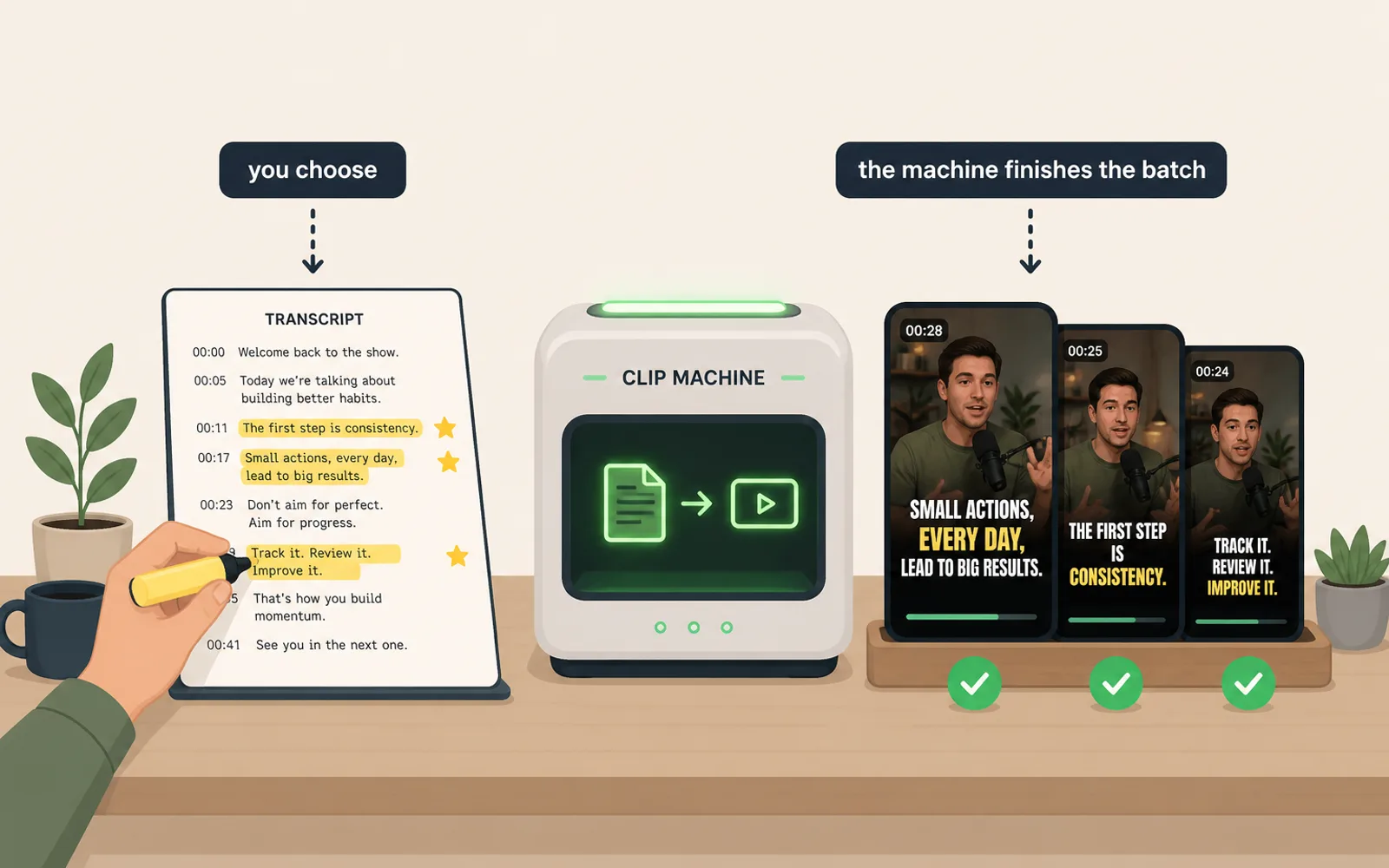
Auto-clip tools promise to turn a long video into Shorts with one click, but they decide which moments become clips — and that is the one decision most creators do not want to give up. The faster, more reliable workflow is to keep the choice for yourself and automate only the repetitive finishing. Here is why full-auto clipping disappoints, and the pipeline that does not.
What auto-clip tools actually promise
Open the landing page of almost any AI clipping tool and the promise is the same: paste a link, drop a file, and the machine returns clips. Underneath, one trade is always being made — the tool decides which moments are worth keeping. That decision is the entire value of a Short, and it is the part a generic algorithm is worst at.
The problem is not that automatic detection is useless. It is that a clip that 'detects well' is not the same as a clip your audience will watch. A spike in loudness, a face, a burst of laughter — those are signals an algorithm can find, and they are not what makes someone stop scrolling. Your best clips usually come from a moment that matters to your specific audience: an inside reference, a counter-intuitive claim, a story beat only you know is the payoff. None of that lives in a waveform.
That is why so many creators report the same pattern: the tool returns a pile of clips that are technically fine and none of them feel right. This is a category-wide complaint, not a bug in one product. When people say editing Shorts takes too long, they are not usually stuck on the cutting — they are stuck deciding, then re-deciding, which moments are the keepers.
Where full-auto clipping fails on the moments that matter
Put two clips side by side and the difference is not technical. Clip A is the loudest three seconds of the video — a shout, a laugh, a cut. Clip B is a quieter line that pays off a story the previous thirty seconds set up. The algorithm reliably finds A. The viewer who has not seen the setup scrolls past A and stays for B — because B means something on its own.
This is the structural weakness of letting the machine pick. A Short has to survive in a feed, next to everything else, with no context. It needs a hook in the first two seconds, a single idea, and a payoff before the end. That is a judgment about narrative, not about signal. An algorithm scores how loud or busy a moment is; it cannot score whether that moment means something to the person who already follows you.
If you want the concrete skill of choosing, the method is the same one editors use on which moments to clip for Shorts: read the transcript, mark the lines that stand alone as a full thought with a start and a payoff, and only then reach for the footage.
What a clip tool should automate for you
The repetitive part of clipping is not choosing — it is everything that happens after you choose, and it is identical on every clip. Once you have picked ten moments from a two-hour video, ten identical jobs remain: take each moment, reframe it to the vertical 9:16 the platforms expect, lay word-by-word captions on it, and export it. None of that is creative. All of it is necessary, and all of it repeats.
This is where a tool earns its place. Doing those three steps once takes minutes; doing them ten times takes an afternoon, and the tenth clip rarely matches the first. A machine that applies one framing rule, one caption style and one export to every clip you marked is doing exactly the job it is good at — consistent, exact, and fast. A machine that also decides which clips to make is doing a job it is bad at. Adobe's guide to aspect ratio makes the same point about vertical format: it is built around a person, so the framing choice carries more weight than the crop itself — which is exactly why that choice, once made, should be reused across the batch rather than re-decided per clip.
- Transcribe the source and read it as text — words are skimmable, video is not.
- Mark the moments that stand alone: a full idea, a start and a payoff.
- Apply reframe, captions and export once, as a rule for the whole batch.
- Review the finished clips cold — as a stranger in a feed would meet them.
That division — you pick, the machine finishes — is the difference between a production line and a slot machine. The machine handles the repetitive pass (see the orange-and-green pipeline in the illustration); the judgment stays with you.
The human-in-the-loop workflow, step by step
Concretely, the workflow that keeps the good clips and drops the grind looks like this. Start with the source in text form, not as footage you scrub. A transcript lets you scan an hour of video in minutes and see where the energy actually sits. You are not watching the video to find clips; you are checking the passages the text already surfaced, then playing back only the ones that read alive.
When you have your keepers, stop working clip by clip. The reason people spend an hour per Short is that they redo the framing decision and the caption pass separately for each one. Instead, set the vertical crop so the subject stays centered — the same rule that makes a manual or auto reframe survive contact with a phone screen — then apply that framing, the caption style and the export to every clip you marked, in one pass. One decision produces a consistent batch instead of ten slightly different decisions.
If you are new to producing several clips from one source, the batch method for many Shorts from one video walks through the same idea from the starting point of a single long piece of content.
Where the tool ends and your judgment begins
Being precise about the boundary is the point, because every tool in this space claims more than it does. A clip production line automates the finishing — the reframe, the captions, the export — applied consistently to the whole batch. It should not pretend to know which moments are interesting to your audience, and you should not want it to: that is the one part where a generic model cannot beat you.
What the machine genuinely should do is the work that has no taste in it. What you should keep is the work that is specific to you: which line is the hook, which story pays off, which moment your own followers will lean into. The line is the same as the difference between producing and editing: editing is deciding what each clip means; producing is finishing ten of them the same way.
This is the honest framing for ClipFinish's clip production line: it turns a source up to two hours into a transcript and you choose the moments. It does not pick them for you — deliberately. What it does is finish the batch: vertical framing, word-by-word captions and export, in the 9:16 the platforms require per YouTube's Shorts guidance. If your source is longer than two hours, you work in segments, the richest hour at a time.
Frequently asked questions
Can AI clip tools pick good moments automatically?
They can find moments with strong signal — loudness, faces, laughter — but a good Short is about narrative, not signal. A moment that means something to your audience almost always needs context an algorithm does not have. Automatic detection is a starting point, not a substitute for your judgment.
What should I automate in the clipping workflow?
The part that repeats on every clip: vertical reframing, captions, and export. Those are identical from one clip to the next, so a machine doing them consistently saves the most time. Choosing which moments become clips is the part worth keeping human.
Do clip tools work with a two-hour podcast or video?
Tools differ. ClipFinish accepts a source up to two hours, turns it into a transcript, and you mark the moments — for a longer recording you work in segments, feeding the richest hour at a time. The method is identical each pass.
Is auto-clipping worth the cost?
It depends what you are paying for. Paying for full-auto moment selection often disappoints, because the tool decides what matters. Paying for batch finishing — reframe, captions and export applied consistently — is usually where the subscription earns itself back in hours.
A clip tool is worth its subscription when it takes over the part that repeats on every clip — the reframing, the captions, the export — and leaves the part that changes every clip to you. That is the opposite trade of the full-auto tools that sell 'paste your video, get clips'. You keep the judgment, because no algorithm knows which line your audience will lean into; you hand the machine the grind, because that grind is identical on every single clip. If you want to see this division on your own footage, ClipFinish's clip production line turns a video up to two hours into a transcript, lets you mark the moments, and finishes the reframe, captions and export on the whole batch — five free minutes a month, no card, no watermark.