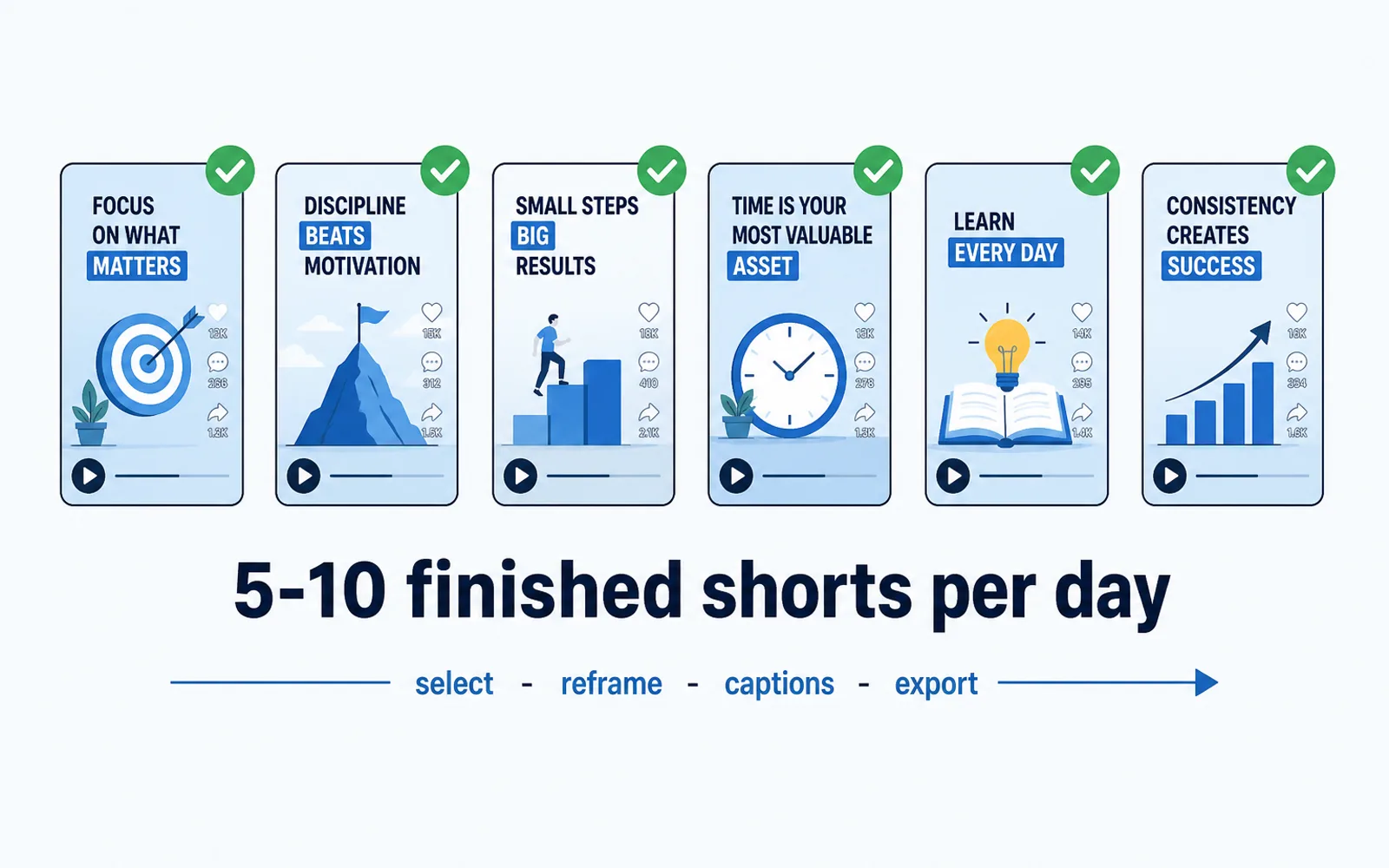
For a solo editor or clipper, the realistic range is roughly three to ten finished Shorts a day — and where you land in that range is decided almost entirely by your workflow, not your talent or your software. A raw cut takes minutes, but a Short that is actually ready to post also has to be reframed, captioned and exported. This article gives you a way to estimate your own number from your own timings, and the single change — working in batches — that most often moves it up.
The honest range: three to ten finished Shorts a day
There is no single number, because 'how many Shorts a day' depends on what counts as finished. If a Short means a raw cut dropped into a feed, one editor can make dozens in a day. But a Short that is actually ready to post is a different job: it has been cut to a moment, reframed to 9:16, captioned, and exported. Counted that way, the realistic range for a solo editor or clipper is roughly three to ten a day.
Where you land in that range has almost nothing to do with talent or software. It is decided by how you structure the work. An editor who spent four hours on two one-minute reels — a complaint that shows up again and again in clipping communities — is not slow; they are redoing the same work twice, once per clip, because the workflow has no shared setup. Someone doing ten finished Shorts a day is usually not editing faster; they are batching.
The rest of this article gives you a way to estimate your own number from your own timings, and the single change — working in batches by task — that most often moves the dial.
Where the time actually goes: the production pass
Cutting the clip is the fast part. In a non-linear editor you can trim a 30-second moment out of a long video in a few minutes. Video editing is a solved, well-documented craft — and the part that is documented as tedious, by the craft's own literature, is everything around the cut.
The time lives in the production pass: reframing the landscape source to a vertical frame without losing the subject, laying captions and syncing their timing to the audio, adding the hook text and the brand packaging, and exporting. Each step is small, but it repeats identically for every clip. That repetition is the real cost — which is why the total time to edit a video into Shorts grows linearly with the number of clips, not the size of the source. Where that time actually goes is laid out step by step in our breakdown of the editing-time budget.
The consequence is arithmetic: if the pass takes twenty minutes per clip, ten clips is more than three hours of pure repetitive work before you have touched a single creative decision.
Why hiring posts ask for '3 Shorts a day' or '10 Shorts a day'
Look at the hiring posts in the clipping space and you will see the same numbers repeated. Agencies advertise work for editors expected to deliver 'simple cuts, zooms, 3 Shorts a day'; campaign operators and community managers ask for five, eight, sometimes ten a day. These are not aspirational marketing numbers — they are throughput targets, and what paid clipping actually pays is usually tied to producing at that cadence.
That is the pressure a paid clipper feels. The operator's quota is set by how much content the channel can absorb, and the clipper who can hit it reliably gets rehired while the one who can't falls off. Producing and publishing several clips a day is the normal rhythm of the format — YouTube even documents a daily upload limit because channels routinely post more than once a day. So the question 'how many Shorts a day' stops being an academic productivity question the moment money is involved: the number is the job. And because the quota is a throughput target, it is won or lost in the production pass, not in the cutting.
The batch method that lifts your number
The change that moves three Shorts a day to eight or ten is not editing faster — it is stopping the repetition. The batching rule is simple: do the same task for every clip in the batch before moving to the next task. Select all the moments first, then reframe them all, then caption them all, then export them all. Every task is set up once and applied across the batch, which is exactly the logic behind the batch method for making multiple Shorts from one video.
The version that scales best automates the pass entirely. Reframing to a subject-tracking 9:16 window, laying a caption style, and exporting in one consistent format are mechanical, repeatable operations — the kind that batch tooling, from the filters and encoders that FFmpeg documents to dedicated clip-production lines, exists to do. That is the gap ClipFinish fills: the clip production line of ClipFinish takes the repetitive per-clip pass out of your hands so your quota stops being a wall.
Where batching stops helping (the honest limits)
The honest limit is that batching and automation only reach the repetitive half of the work. The decisions still have to be made by a human: which moment is worth clipping, whether the hook lands in the first three seconds, which caption phrasing fits the creator's voice. No pass, batched or automated, chooses your best line for you.
So the workflow splits cleanly. The creative decisions — the 20% of the work that decides whether a clip performs — stay yours and should stay slow and careful. The mechanical pass — the 80% that repeats — is where throughput is won. Automate the mechanical part and you buy back the time to spend on the decisions that actually move views. There is no tool that does your judging for you; the tools that are worth it simply stop wasting your day on the part a machine can already do.
How many Shorts should a beginner aim for? (FAQ)
- How many Shorts can a beginner realistically make in a day?
- If 'finished' means reframed, captioned and exported, expect three to five a day at the start. The number rises quickly once you batch by task rather than finishing each clip top to bottom.
- Is 5 Shorts a day too many?
- No. Posting frequency is a content decision, not a penalty, and five is within the normal range for short-form channels running regular output. What matters is that each one holds retention.
- How long does it take to edit one Short?
- A raw cut can take minutes; a finished Short — reframed, captioned and exported — typically takes fifteen to thirty minutes by hand, and far less once the repetitive pass is automated.
- Does producing more clips actually improve performance?
- Volume gives you more chances to find what your audience holds, which is why campaign quotas exist. But volume only pays off if each clip still clears a quality bar — more weak clips is not a strategy.
A realistic answer to 'how many Shorts a day' is three to ten finished clips, and the honest news is that where you land is mostly a workflow question. Keep the creative decisions slow and careful; batch the mechanical pass so it stops multiplying. Estimate your own number by timing each step of your production pass once — then attack the step that repeats. That step is the part ClipFinish removes, so you can spend the day making the decisions that matter instead of redoing the ones that don't.