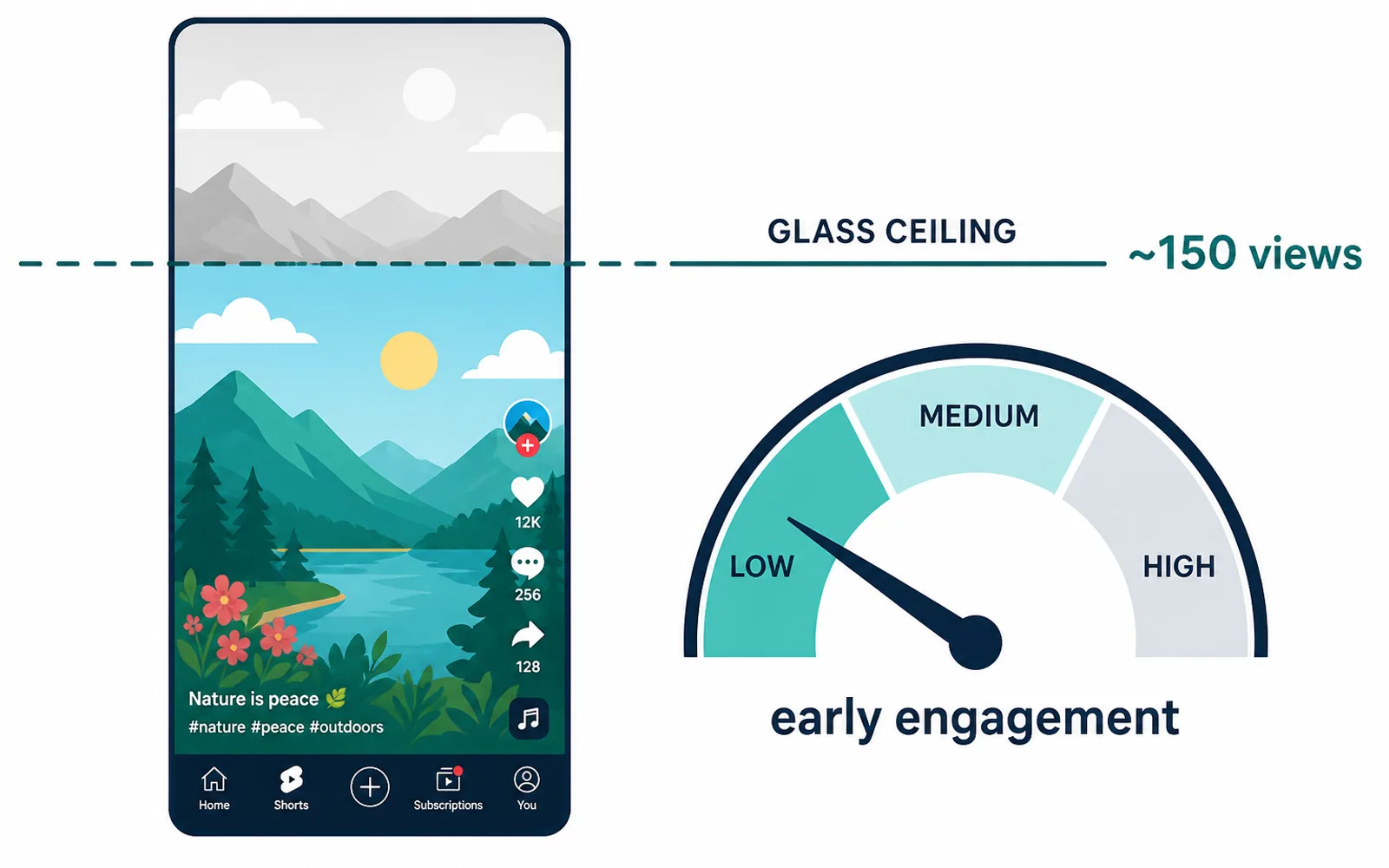
Your Shorts keep flattening out at a few hundred views, and someone told you it's because the account is still 'cold' and needs warming up. It isn't. The platform shows each new clip to a small test group, and if they swipe away fast, the push stops — usually before you ever see your best content. Here is how that test actually works and the two levers that move the number.
Why your clip stalls at a few hundred views
The platform does not show your clip to everyone at once. It shows it to a small test group — often a few hundred people — and watches what they do in the first seconds and first minutes. If enough of them keep watching, it pushes the clip to a bigger group; if they swipe away, the push ends. TikTok's own description of how it recommends content and YouTube's explanation of how it surfaces videos describe the same loop: a clip grows only when the first small audience holds it.
This is why so many new accounts plateau around 100 to 200 views. It is not a penalty and not a shadowban — it is a small group making a fast decision. A clip that flattens at 150 views did not fail because the account is young; it failed its first test. That distinction matters, because it points at the fix: not account age, but the clip itself.
Why 'warming up your account' is mostly a myth
The belief that a new account needs a warmup period before the algorithm will push anything is widespread and mostly wrong. There is no hidden counter that unlocks once the account is old enough. What a cold account actually lacks has nothing to do with age: every clip is still unknown to the system, so each one is judged purely on its own early engagement.
The useful kernel inside the warmup advice is consistency and volume. Posting regularly gives the system data about what your audience responds to, and that improves targeting over time. But 'warming up' by publishing filler that nobody watches does the opposite of help: weak early engagement is exactly what caps reach, so a week of low-effort posts can leave the account stuck right where it started.
The fix is not to warm up the account — it is to warm up the audience, by posting clips that people actually finish.
What the test measures first: the first three seconds
In a feed that can be swiped in under a second, the strongest signal is whether people stay past the opening. The first three seconds — the hook — decide most of the test outcome. If the clip opens with a slow intro, a logo, or a 'like and subscribe', the test group swipes and the push ends before anyone sees the content you are proud of.
A hook that holds is specific: a payoff promised up front, a surprising moment, or a question the viewer needs answered. Then retention decides the rest — does enough of the clip get watched, and does anyone rewatch it? Muted viewing counts too, because a large share of Shorts are watched with sound off; that is precisely why captions lift retention on clips that would otherwise be swiped. Getting the moment right is the other half — a clip is only as strong as the moment you choose to cut.
The lever people miss: produce more clips, run more tests
Here is the arithmetic most beginners miss. Each clip is one test. Produce one clip a week and the algorithm runs one test a week — you learn what works at the speed of one data point per week. Produce a batch of ten clips from the same source and you run ten tests, and the system gets ten chances to find the audience that responds.
View counts follow testing volume far more than they follow polish. The blocker is rarely inspiration — it is that the mechanical pass, reframing to vertical, laying captions, exporting, makes each clip so slow that volume feels impossible. That is the gap ClipFinish fills: the clip production line takes the repetitive per-clip work out of your hands so producing a batch stops being a week of grind. It does not buy views and does not fake engagement — it simply removes the cost that stops you from running enough tests.
What moving the number actually takes
Put it together and the plan is short. You cannot control the test group, but you can control every input that decides it:
- Pick a stronger moment — a clip is only as good as the line you cut.
- Sharpen the first three seconds so the swipe stops.
- Hold people to the end with captions and pacing.
- Produce enough clips that the system has data to work with.
Do these in order, and the plateau stops being a mystery. The first three are creative work you should keep. The fourth is volume — and it is the one that most often stalls, because the mechanical pass eats the time you meant to spend on it.
Do I need to warm up my account before posting Shorts?
- Do I need to warm up my account before posting Shorts?
- No. There is no warmup period that unlocks reach. A new account's clips are judged on early engagement like any other; consistency and volume help by giving the system data, but posting low-effort filler 'to warm up' can keep the account stuck.
- How many views is normal for a new Short account?
- Anything from a few hundred up is a normal early range, because every new clip starts from a small test group. The plateau at 100–200 views means the first test didn't hold, not that the account is broken.
- Why did one of my clips get views and the rest not?
- Because each clip runs its own test. The one that got views had a hook and retention strong enough to push past the first group; the others didn't. That is the signal to make more like the winner.
- Does posting more clips actually help?
- Yes, within reason. More clips means more tests, which means more chances for the system to find your audience — and more data about what that audience holds to the end.
A Short's reach is decided in its first minutes by early engagement, and early engagement is decided by things you can control: the hook in the first three seconds, retention to the end, and the number of tests you run. There is no warmup period to unlock and no hidden counter to fill. Stop polishing one clip and start running more tests: pick stronger moments, sharpen the opening, hold people to the end with captions, and produce enough clips that the system has real data about your audience. That last step is the one that usually stalls — and it's exactly the part ClipFinish removes.